

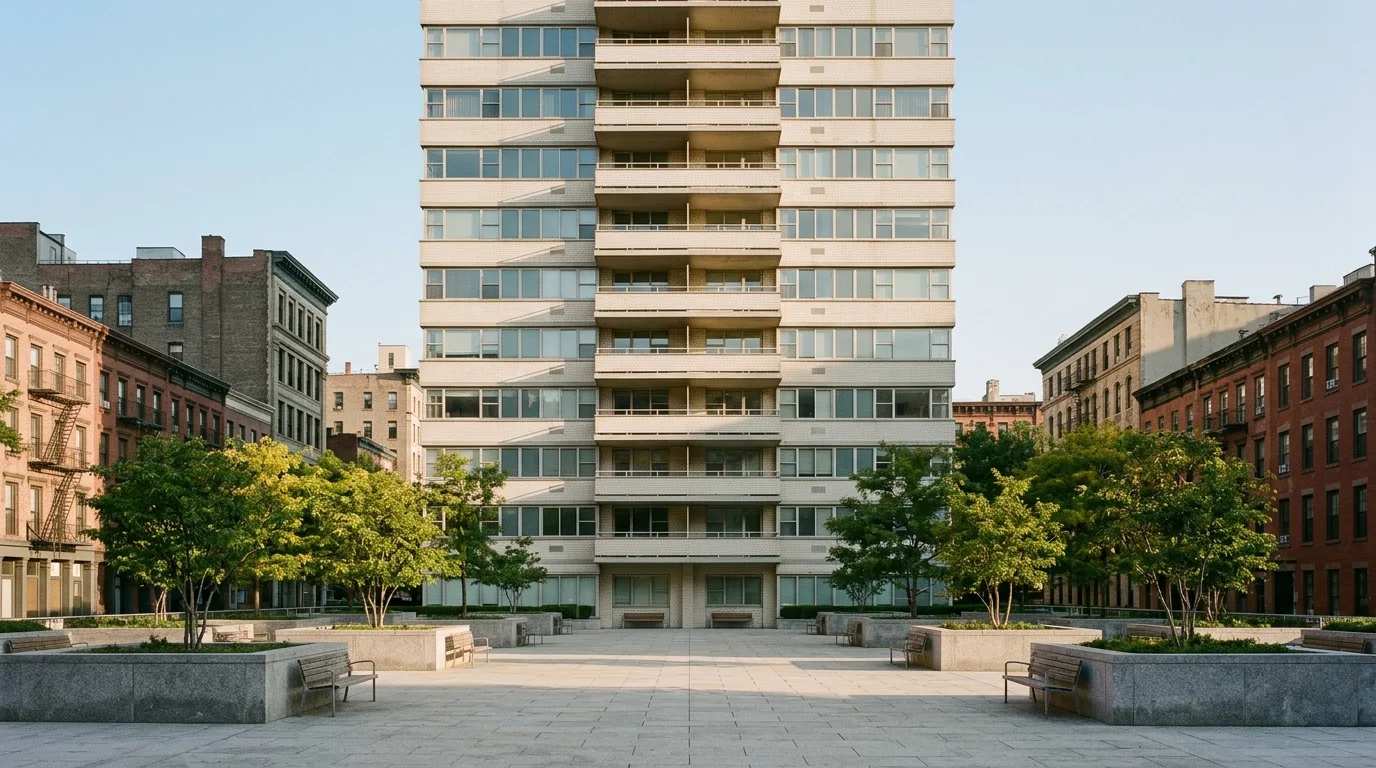
60 East 8th Street, the building known as Georgetown Plaza, is a 31-floor tower with 390 apartments at the southeast corner of East 8th and Mercer Streets in Greenwich Village, completed in the mid-1960s. City records show it is a condop: a three-unit condominium whose residential unit belongs to a cooperative corporation, and Ed Hardesty has sold more than 30 apartments here over 20 years.
Every building fact below comes from a New York City or New York State record, checked on October 21, 2026, and listed at the end.
Georgetown Plaza at a glance
Georgetown Plaza is condominium number 797 on Manhattan block 548: one billing lot over three unit lots, with the residential unit owned by Georgetown Plaza Owners Corp.
| Item | The record | Source |
|---|---|---|
| Name | Georgetown Plaza | City Planning, privately owned public space record M020001 |
| Address | 60 East 8th Street, New York, NY 10003 | PLUTO |
| Location | Southeast corner of East 8th and Mercer Streets, running east to Broadway; the Buildings Department lists the building at 60 to 74 East 8th Street, 743 to 755 Broadway and 302 to 310 Mercer Street | City Planning POPS record; Department of Buildings property profile |
| Tax lot | Block 548, billing lot 7501 (BBL 1005487501); unit lots 1001, 1002 and 1003 | PLUTO; Department of Finance |
| Building identification number | 1080855 | City Planning; Department of Buildings |
| Floors | 31 | PLUTO 26v2 |
| Apartments | 390 residential units, 392 units in all | PLUTO 26v2; Department of Finance |
| Year built | 1965 in PLUTO, whose dictionary calls the field accurate to the decade; 1966 as the year completed in the plaza record | PLUTO and its data dictionary; City Planning |
| Ownership type | Condop: a garage unit, a retail unit and a residential unit classed R9, co-op within a condominium | Department of Finance |
| Condominium declaration | Recorded December 3, 1991, with the condominium plans | ACRIS |
| Zoning district | C6-4 | PLUTO 26v2 |
| Historic district | None; not an individual landmark | Landmarks Preservation Commission; PLUTO |
| Public space | A plaza of 10,975 square feet, required to be open 24 hours | City Planning POPS record |
| Nearest subway | 8 St-NYU, R and W trains | MTA |
Georgetown Plaza is a condop, and the apartments are co-op shares
60 East 8th Street is a condop. The building is legally a condominium of three units, and the residential unit, which holds all 390 apartments, is owned by a cooperative corporation, so buying an apartment here means buying co-op shares, not a condominium unit.
Listings disagree, calling it a condop or a co-op, and both are partly right. The Department of Finance divides the building into three condominium unit lots under one billing lot:
- Unit lot 1001, labeled “GAR”, class RG: indoor parking.
- Unit lot 1002, labeled “RET”, class RK: retail space, 11,515 square feet.
- Unit lot 1003, labeled “RES”, class R9: a co-op within a condominium, owned by Georgetown Plaza Owners Corp. and holding 390 co-op apartments.
- Billing lot 7501, class R0: the special condominium billing lot that ties the three units together.
The condominium came later than the building. ACRIS, the city’s register of recorded documents, holds a declaration and condominium plans recorded on December 3, 1991, and the Department of Finance dates the unit lots to January 7, 1992. HPD’s building registration agrees: the corporate owner is Georgetown Plaza Owners Corp., described as a co-op.
What that means for an apartment owner
The New York State Attorney General explains a co-op purchase plainly: “In a cooperative (co-op), a purchaser buys shares in a corporation. Those shares are allocated to a specific apartment. Ownership of the shares entitles the purchaser to a long-term proprietary lease for the apartment.” At Georgetown Plaza, the corporation is Georgetown Plaza Owners Corp., and the shares, the proprietary lease and the co-op’s rules govern every apartment.
The public record reflects this. When an apartment here sells, ACRIS shows no deed. It shows a transfer tax filing, usually a combined city and state one, indexed to unit lot 1003 with the apartment number and the property type “single residential coop unit.” The garage and the stores are separate condominium units with an owner of record other than the co-op, and they are not part of what an apartment buyer acquires.
Ed puts the general difference simply: a condominium is real property, so the board is less of an issue. At Georgetown Plaza the apartments are co-op shares, so the co-op board is part of every sale.
The trap: reading “condop” as “condo”
Many owners assume condop means the apartments sell like condominiums. At Georgetown Plaza they do not. The condominium layer sits above the apartments, dividing the building between the co-op, the garage and the stores. Each apartment is a co-op apartment, and New York’s offering plan rules require a co-op’s plan to discuss any restrictions on a shareholder’s right to use, sell, lease or pledge the shares, and the fees for doing so. Plan a sale or a sublet here on co-op terms.
Where it sits: East 8th Street between Mercer Street and Broadway
Georgetown Plaza stands at the southeast corner of East 8th and Mercer Streets, with stores along its Broadway side, in the part of Greenwich Village between Washington Square Park and Astor Place, in Manhattan Community District 2.
City Planning’s 2020 neighborhood map places the lot in the Greenwich Village tabulation area. Washington Square Park is about 600 feet to the west, edge to edge on the Parks Department’s map, and Union Square Park about 1,600 feet to the north. Individual landmarks within a few blocks include Grace Church at 800 Broadway, designated in 1966, and the Astor Library at 425 Lafayette Street, designated in 1965.
Subway stations near 60 East 8th Street
The 8 St-NYU station is next to the building: the MTA lists eight stairways for it, the nearest about 110 feet from the center of the lot.
| Station (MTA name) | Daytime routes | Straight-line distance from the lot’s center |
|---|---|---|
| 8 St-NYU | R, W | About 140 feet |
| Astor Pl | 6 | About 580 feet |
| 14 St-Union Sq | 4, 5, 6, L, N, Q, R, W | About 1,700 to 2,000 feet |
| Bleecker St | 6 | About 1,730 feet |
| Broadway-Lafayette St | B, D, F, M | About 2,090 feet |
| 3 Av | L | About 2,110 feet |
| W 4 St-Wash Sq | A, C, E, B, D, F, M | About 2,160 feet |
Distances are straight lines from MTA station coordinates to the lot’s PLUTO coordinates, not walking routes.
Landmark status: outside every historic district
60 East 8th Street is not inside the Greenwich Village Historic District or any other historic district, and it is not an individual landmark. The lot’s outline touches none of the Landmarks Preservation Commission’s district boundaries or landmark sites, and PLUTO leaves its historic district field blank.
Two districts are close. The NoHo Historic District, designated in 1999, comes within about 60 feet of the lot, and the Greenwich Village Historic District, designated in 1969, is about 500 feet away. The Commission’s guidance says that “most exterior changes to the front and rear facades of buildings in historic districts require review by LPC.” That review does not apply here, so exterior and window work is a matter for the building’s own rules and the Department of Buildings.
The plaza is a privately owned public space
The open space beside the building is a privately owned public space, listed by the Department of City Planning as record M020001. The city describes these spaces as “outdoor and indoor spaces provided for public enjoyment by private owners in exchange for bonus floor area or waivers, an incentive first introduced into New York City’s zoning regulations in 1961.”
The record lists a plaza of 10,975 square feet, required to be open 24 hours, with no required amenities. The plaza is public by zoning, not a private forecourt.
Lines and layouts: how the apartments are numbered
Each apartment here is identified by a floor number and a line letter, and a line is the vertical stack of apartments that share a letter and, usually, a floor plan.
In the ACRIS records we reviewed, apartment letters run from A to P without I or O, which allows up to fourteen lines on a floor, and apartment numbers run from 4 to 34 with no 13. The numbering on the door is a label, not a floor count: PLUTO counts 31 floors, the highest apartment numbers begin with 34, and a 2012 Department of Buildings filing describes apartments 34K and 34L as being on the 31st floor. When you compare floors, compare the building’s floor plans, not the apartment numbers.
Combined apartments leave a public record
Owners here have combined neighboring apartments since at least 2000, and a combination filed with the Department of Buildings leaves a public record. Combination filings since 2000 include 28K and 28L, 26B and 26C, 4B and 4C, 16B and 16C, 12K and 12L, 20A and 20P, 27E and 27F, 33B and 33C, 10K and 10L, 4F and 4G, and 20E and 20F. The record also runs the other way: a 2013 filing, signed off that year, reinstated 24K and 24L as two separate apartments, and a 2019 filing, also signed off, separated the 28K and 28L combination filed in 2000. A 2026 filing describes an apartment being changed from two bedrooms to three.
Each recorded pair is two apartments on the same floor, and three pairings recur: K with L, B with C, and E with F. A 2017 facade filing also covers concrete repair at balconies on floors 5 through 31. Ed can walk you through how the lines differ in size, exposure and view; ask him about the line you own or are considering.
Own at Georgetown Plaza, or thinking about it?
Start with your line, your floor and your timing. Ed will tell you how buyers are likely to compare your apartment with others in the building.
Talk with EdOwning at Georgetown Plaza: the documents that set the rules
As an owner here you hold shares in Georgetown Plaza Owners Corp. and a proprietary lease, and the co-op’s documents set most of the day-to-day rules that govern your apartment. The condominium declaration recorded in 1991 sits above them and ties the co-op’s unit to the garage and the stores.
The Attorney General’s guide to co-op boards says a board “must exercise prudent business judgment in making decisions, just like any other corporate board,” and “must follow the co-op’s internal rules (as set forth in the by-laws, the proprietary lease, the certificate of incorporation and the house rules).” It warns that the original offering plan may not be current.
Shareholders also have records rights under the Business Corporation Law: to examine minutes of shareholder meetings, the record of shareholders, and the annual balance sheet and profit and loss statement (section 624), and to an annual report, signed by each director, on contracts in which a director had an interest (section 727), which the Attorney General encourages prospective purchasers to read before entering into a contract of sale.
Who to ask
Start with the managing agent. HPD’s current registration for the building, filed September 15, 2026 and running to September 1, 2027, names FirstService Residential as the managing agent; agents change, so confirm it before you request documents. Ask for the current proprietary lease, by-laws and house rules, the purchase application, the alteration agreement if you plan work, and how parking is offered to apartment owners, since the garage is a separate condominium unit.
Renting out or subletting your apartment
Whether you can rent out an apartment at Georgetown Plaza, for how long and on what terms is set by the co-op, not by the city, and the policy can change, so get the current sublet policy in writing from the managing agent before you sign a lease with anyone.
The Attorney General names “sublet provisions” among the terms a co-op’s by-laws and proprietary lease set out, and the offering plan rules require a co-op’s plan to discuss restrictions on a shareholder’s right to lease and any fees for doing so. In practice, a co-op sublet customarily goes through an application to the board, much like a sale.
The Hardesty Team works with owners who want to rent out their apartments, as the landlord’s representative, not with renters. If you are moving out of New York City and deciding whether to keep the apartment, read our guide to the NYC pied-à-terre tax and whether to keep your Manhattan apartment before you decide.
Selling an apartment at 60 East 8th Street
Selling here is a co-op sale: the buyer is buying your shares and proprietary lease, the co-op board reviews the buyer, and the price a buyer will pay turns on the line, the floor, the exposure and the condition of your apartment against the others in the building.
What buyers compare
With 390 apartments and up to fourteen lines on a floor, a buyer here compares your apartment with the same line on other floors, the neighboring lines and any combined apartments for sale, on four points:
- The line: its plan, its size and whether it has a balcony.
- The floor and the view: buyers compare the same line floor by floor.
- The exposure: which way the apartment faces, and how much light it gets.
- The condition and the paperwork: a renovation or a combination is worth more to a buyer when its Department of Buildings filings and the co-op’s alteration approvals are in order. A buyer’s attorney customarily asks for them.
The board package and the timeline
Your buyer prepares a purchase application for the Georgetown Plaza Owners Corp. board, and the managing agent and the board review it before closing. The stages are the same as in any Manhattan co-op, and our guide to how long it takes to sell a co-op in Manhattan walks through each one.
In Ed’s words
“I think the things people most need to understand in a co-op in New York are how long that process takes and what the expectations of the boards are, because it is very opaque and harder to know for sure what they’re looking for. That just takes years of doing it, and understanding a buyer’s finances when you’re considering them for a building.”
The costs of selling
A sale of shares here is reported to the city and the state through transfer tax filings in ACRIS. The co-op may also charge a transfer fee, often called a flip tax, if its documents provide for one; ask the managing agent for the current terms. Our guide to who pays transfer tax and the mansion tax in NYC, and how flip taxes work covers the rates and who customarily pays each one.
If you are selling to move to Westchester
If you are buying a house in Westchester as you sell here, the timing of the two closings is the hard part, and our guide to selling a Manhattan apartment and buying in Westchester at the same time covers the order of steps.
Ed’s record at Georgetown Plaza
Ed has sold more than 30 apartments at 60 East 8th Street over 20 years. He is a Licensed Associate Real Estate Broker at Compass, licensed in New York since 1994, and he works from the Compass office at 110 Fifth Avenue in Manhattan under license 10301206146.
Ed began registering domain names and making videos for individual buildings in 2012 and 2013, and he still keeps a single-building website for Georgetown Plaza at 60east8th.com. His 2023 video introduction to the building is on our Georgetown Plaza video post, and the team’s past sales are on our past transactions page.
Frequently asked questions
60 East 8th Street, Georgetown Plaza, is a condop. New York City Department of Finance records divide the building into three condominium units: a garage unit, a retail unit and a residential unit classed R9, co-op within a condominium, owned by Georgetown Plaza Owners Corp. All 390 apartments sit inside that unit, so buying an apartment at Georgetown Plaza means buying co-op shares and a proprietary lease, not a deed.
Georgetown Plaza is at 60 East 8th Street, New York, NY 10003, at the southeast corner of East 8th and Mercer Streets in Greenwich Village, with stores on its Broadway frontage. Its condominium billing lot is Manhattan block 548, lot 7501. Washington Square Park is about 600 feet west, and the 8 St-NYU station, served by the R and W trains, is about 140 feet from the center of the lot.
60 East 8th Street has 31 floors and 390 residential apartments, according to the city’s PLUTO tax lot data, version 26v2, and the Department of Finance’s 2027 assessment records. Older city records, and some listings, show 389. PLUTO lists the year built as 1965, a field its dictionary calls accurate to the decade, and City Planning’s public space record gives 1966 as the year completed. Apartment numbers run as high as 34, so they do not match the floor count.
No. Georgetown Plaza at 60 East 8th Street is not inside the Greenwich Village Historic District or any other historic district mapped by the Landmarks Preservation Commission, and it is not an individual landmark. The nearest district boundary, the NoHo Historic District’s, comes within about 60 feet of the lot, and the Greenwich Village Historic District is about 500 feet away, so Landmarks Commission review of exterior changes does not apply to the building.
The plaza at Georgetown Plaza, 60 East 8th Street, is a privately owned public space, record M020001 in the Department of City Planning’s database. The record lists a plaza of 10,975 square feet, required to be open 24 hours, with no required amenities. City Planning describes these spaces as provided for public enjoyment by private owners in exchange for bonus floor area or waivers, an incentive first introduced in the city’s zoning rules in 1961.
The nearest subway station to 60 East 8th Street is 8 St-NYU on Broadway, with R and W daytime service, about 140 feet from the center of the lot in a straight line, according to MTA station data. Astor Pl, on the 6, is about 580 feet away. 14 St-Union Sq, Bleecker St, Broadway-Lafayette St and W 4 St-Wash Sq are each roughly 1,700 to 2,200 feet away.
Renting out or subletting an apartment at Georgetown Plaza, 60 East 8th Street, is governed by the co-op’s proprietary lease, by-laws and board policy, not by a city rule, and the policy can change. Before you list the apartment for rent, get the current sublet policy and application from the managing agent in writing. The Hardesty Team works with owners who rent out their apartments.
Yes. The Department of Finance records a garage unit at 60 East 8th Street, unit lot 1001, labeled GAR and classed RG, indoor parking, and the Department of Buildings received a garage repair filing for the building in April 2025. The garage is a separate condominium unit owned apart from the Georgetown Plaza co-op, so ask the managing agent how parking is offered to apartment owners before you count on a space.
Selling an apartment at 60 East 8th Street is a co-op share sale. You and your buyer sign a contract through your attorneys, the buyer applies to the Georgetown Plaza Owners Corp. board, and the closing transfers your shares and proprietary lease, with transfer tax filings in ACRIS. The price depends on the line, floor, exposure and condition against other apartments in the building.
Yes. Ed Hardesty, a Licensed Associate Real Estate Broker at Compass who leads The Hardesty Team with Theresa Ferraro, has sold more than 30 apartments at 60 East 8th Street, Georgetown Plaza, over 20 years. He keeps a single-building website for Georgetown Plaza and works from the Compass office at 110 Fifth Avenue in Manhattan. Reach him at (917) 749-9071 or ehardesty@compass.com.
Related guides
- Ed Hardesty, Associate Real Estate Broker at Compass in Manhattan and Westchester
- How long it takes to sell a co-op in Manhattan: the board package, approval and closing
- Who pays transfer tax and the mansion tax in NYC: seller closing costs and flip taxes
- NYC pied-à-terre tax: should you keep your Manhattan apartment after you move?
- Selling a Manhattan apartment and buying in Westchester at the same time
- 60 East 8th Street building page
- What’s my New York City apartment worth?
Talk with Ed about your apartment at Georgetown Plaza
A Hardesty Team partner has been named to Westchester Magazine’s Top Real Estate Agents list every year since 2023, and the team is ranked second among Dobbs Ferry teams by sales volume on the 2026 RealTrends Verified list. If you own at 60 East 8th Street and want to know what your line, floor and condition mean for a sale or a rental, Ed will walk you through it.
Contact The Hardesty TeamSources
- NYC Department of City Planning, PLUTO, version 26v2, August 2026, BBL 1005487501, and the PLUTO Data Dictionary, August 2026
- NYC Department of Finance, Property Valuation and Assessment Data, assessment years 2023 to 2027, block 548, and Building Classification codes
- NYC Department of Finance, ACRIS, block 548, lots 54, 1001, 1002 and 1003, 1991 to 2026, via the Real Property Master and Real Property Legals datasets
- NYC Department of Housing Preservation and Development, HPD Online, building 11285, registration filed September 15, 2026, and the Multiple Dwelling Registrations and Registration Contacts datasets
- NYC Department of City Planning, Privately Owned Public Spaces, version 25v2, record M020001, and 2020 Neighborhood Tabulation Areas
- NYC Landmarks Preservation Commission, Historic Districts and Individual Landmark Sites, June 2026, and Permits and Making Alterations
- NYC Department of Buildings, Job Application Filings and DOB NOW: Build filings, building 1080855, 2000 to 2026, and the Buildings Information System property profile for BIN 1080855
- NYC Department of Parks and Recreation, Parks Properties
- Metropolitan Transportation Authority, MTA Subway Stations, October 2026, and Subway Entrances and Exits, 2024
- New York State Attorney General, Cooperatives, Understanding and Dealing With a Co-op Board of Directors, and 13 NYCRR 18.3
- New York State Senate, Business Corporation Law section 624 and section 727
- Westchester Magazine agent lists, 2023, 2024, 2025 and 2026, and the RealTrends Verified team profile, 2026 list based on 2025 sales data
All records were checked on October 21, 2026. Distances are straight-line measurements from official coordinates and map outlines. This guide is general information, not legal, tax or financial advice. Confirm the details for your own situation with a New York real estate attorney, a tax professional or your lender.
Social Cookies
Social Cookies are used to enable you to share pages and content you find interesting throughout the website through third-party social networking or other websites (including, potentially for advertising purposes related to social networking).